
NTU logo

Full-time Student

M.Sc. Data Science

Nanyang Technological University, Singapore

After leading teams, earning recognition, and operating in my comfort zone at POI-TECH, I chose to step away. I knew AI was reshaping everything, and I wanted to be on the right side of that shift. Singapore, NTU and a deep dive into data science felt like the only honest next step.

Academic Projects

AI6130LLMRAGCUADEvaluation Design

Finding High-Risk Clauses in Legal Contracts with LLMs and RAG

510 contracts
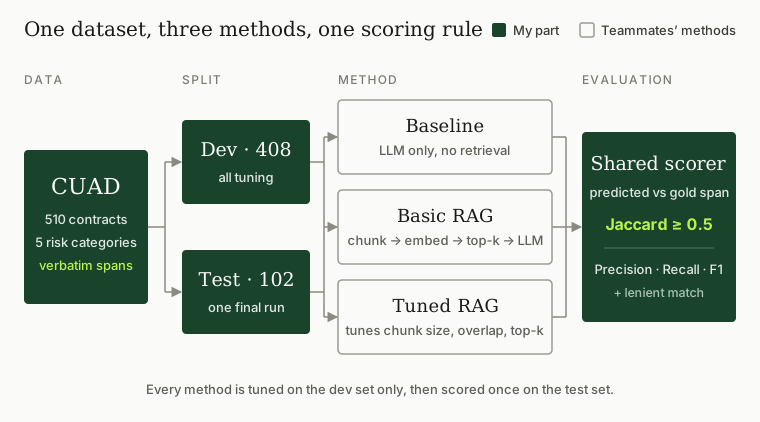
CUAD, annotated by legal experts; 408 for tuning and 102 held out for one final run
5 risk categories
Picked for legal risk, enough test examples and short clause spans
51.5% F1
Best tuned RAG system on the 102 held-out contracts, 11.9 points above basic RAG
Diagram: 510 CUAD contracts split into 408 for tuning and 102 for the final test, three methods (baseline, basic RAG, tuned RAG) producing verbatim clause spans, all scored by one shared evaluator.
  • Group project: extract high-risk clauses word for word from contracts, comparing a plain LLM, basic RAG and tuned RAG. I owned the dataset and the evaluation every method runs on.
  • Picked five clause types. 28 of the 102 test contracts contain none of them, so the test also checks whether a model can say “nothing here”.
  • Built the shared data loader, prediction format and scoring script (CUAD's Jaccard ≥ 0.5 rule), and stress-tested the metric: padding each correct span with 400 extra characters drops F1 from 1.00 to 0.25.
  • Result: on the held-out contracts, the team's tuned RAG reached 51.5% micro-F1 with its best model, up 11.9 points on basic RAG, and its retrieval reached 76% of the expert-marked clauses.
AI6103PyTorchCLIPQwen2.5-VLvLLM

Improving LaBo: A Vision-Language Model Takes a Second Look

11 datasets
The few-shot image classification benchmarks from the original paper, at 1 to 16 shots
+8.3 points
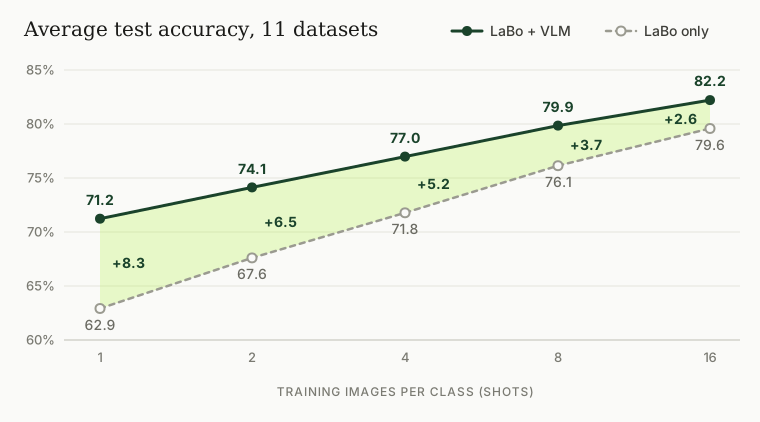
Average 1-shot test accuracy, 62.9% → 71.2%; +5.3 points across all shot counts
5 questions per image
The VLM only re-checks LaBo’s top 5 classes; nothing is retrained or fine-tuned
Line chart of average test accuracy on 11 datasets from 1 to 16 shots: LaBo + VLM stays above LaBo alone at every shot count.
  • Group project to improve LaBo, a concept-bottleneck image classifier from a CVPR paper. I designed and ran the LaBo + VLM part.
  • With few training images LaBo often misses the top answer but comes close: the right label is in its top 5 for 77–99.9% of test images on 10 of the 11 datasets.
  • So I added a second look. Qwen2.5-VL-7B checks each of the 5 candidates (“Is this a photo of a ⟨class⟩?”) and its “Yes” probability is blended with LaBo’s score. Each image is encoded once and answers are cached, on one NVIDIA A40 per job.
  • Result: +8.3 points at 1 shot and +5.3 across all shot counts, with the largest gain on ImageNet (+16.9 points at 1 shot).
PythonLLM EvaluationData Analysis

Safety Evaluation of AI-Generated Driving Videos

Proposal
A research plan: the evaluation was designed, not yet built
3 error levels
Semantic, logical and decision-level failures
LLM scoring
Planned prompts that let an LLM rate each video for safety automatically
  • Proposed a pipeline that checks videos from generative driving models for semantic, logical and decision-level safety errors.
  • Planned a labelled set of 100+ videos and drafted the LLM prompts that would score them automatically.
PostgreSQLPython

DBLP in PostgreSQL: Parsing, Schema Design and Query Tuning

PostgreSQL
A relational schema for academic publication data
XML → SQL
One pipeline from the raw DBLP XML file to structured tables
Indexing study
Query speed measured across database sizes and index choices
  • Designed a PostgreSQL schema for academic publication data and loaded the raw DBLP XML into it.
  • Measured query speed across database sizes and index choices to see how it scales.

More Coursework

Three smaller assignments

01

AI6130 · Large Language Models

Evaluating Small LLMs on Multiple-Choice QA

Individual assignment

Scored four open models (1.1B to 4B parameters) on CommonsenseQA, OpenbookQA and PIQA with baseline, zero-shot and few-shot prompts. Prompt format mattered more than examples: a clear zero-shot prompt lifted Qwen2.5-3B from 32% to 80%, and few-shot added nothing.

Qwen2.5-3B average accuracy, baseline vs zero-shot prompt
32% → 80%
models, benchmarks and prompt settings evaluated
4 × 3 × 3

02

AI6130 · Large Language Models

LoRA vs AdapterP for Maths Word Problems

Individual assignment

Fine-tuned TinyLlama-1.1B and OpenLLaMA-3B on step-by-step maths solutions with LoRA and AdapterP, on free Kaggle GPUs. On the 3B model AdapterP trains 15 times as many parameters, yet LoRA won on three of the four arithmetic test sets.

trainable parameters on the 3B model, LoRA vs AdapterP
0.08% vs 1.2%
AddSub accuracy, LoRA vs AdapterP (5.3% before fine-tuning)
44.1% vs 32.7%

03

AI6122 · Text Data Management & Processing

Yelp Review Analysis and Search

Group assignment · data pipeline and corpus statistics

Joined 6.99 million Yelp reviews to their businesses and drew a hashed 10% sample, so all five teammates worked on identical data. Fitted Zipf’s and Heaps’ laws; teammates built the tokeniser, BM25 search and trend analysis on top.

reviews in the shared working sample
700,270
Heaps’ law exponent: vocabulary grows sublinearly (R² > 0.999)
β ≈ 0.48